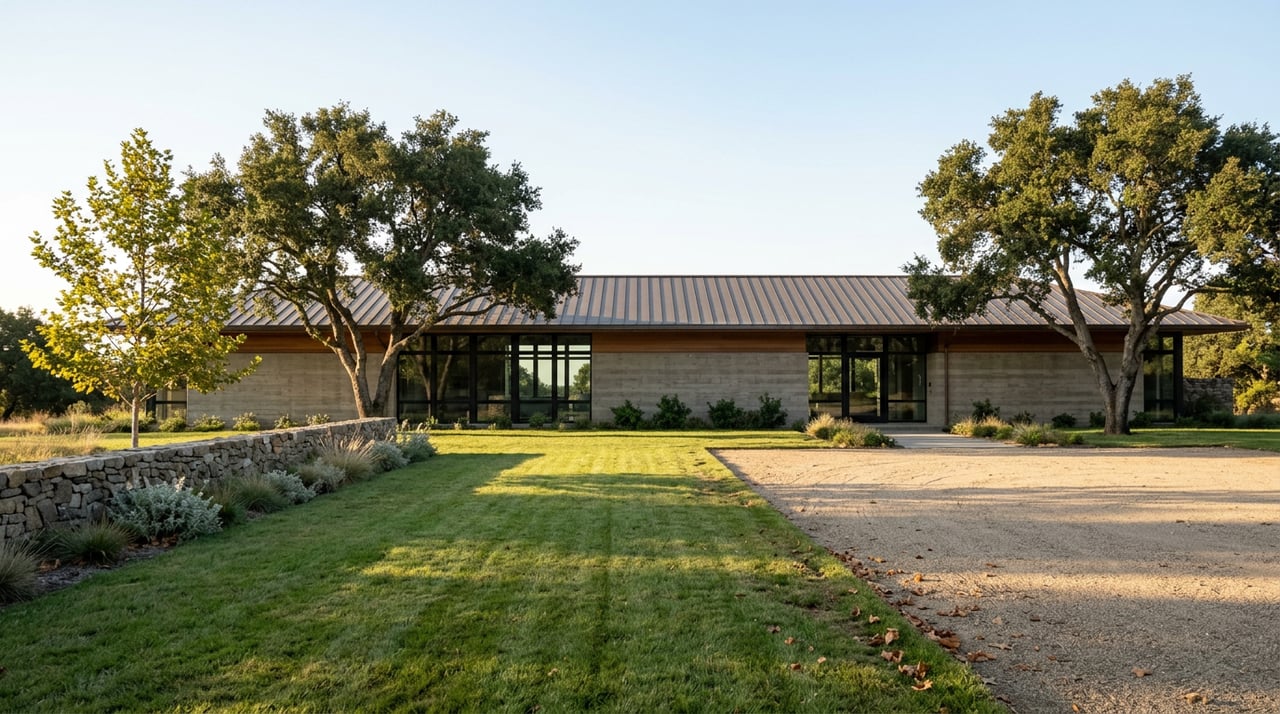
Why the Poway Real Estate Market Shows Two Stories
September 3, 2026
September 3, 2026
Pull up Poway's median home price on three different sites this week and you will get three different answers, and none of them are wrong. One shows the median falling double digits over the past year. Another shows it essentially flat. A third, looking at the same zip code from a different angle, shows it climbing sharply. That is not a data glitch. It is what happens when a city's housing stock is split into two markets that almost never behave the same way in the same month, and Poway has been built that way on purpose since the 1980s.
The split has a name, a code section, and a reason it will not go away. Understanding it matters if you are comparing Poway to Rancho Bernardo, Scripps Ranch, or anywhere else in North County and trying to figure out what a "typical" home actually costs here.
Poway's municipal code carves out three residential rural zones, RR-A, RR-B, and RR-C, that require a minimum lot size of one acre and cap density at one unit per acre. That part is fairly standard for a city with a rural pocket. What is not standard is what happens if anyone wants to change it.
Under the code, land zoned RR-A, RR-B, or RR-C cannot be rezoned to allow smaller lots or higher density unless Poway voters approve it directly at an election. The City Council cannot make that change on its own. It has to go to the ballot. That single clause means the large-lot, acre-minimum sections of Poway, Green Valley's older enclaves, the Espola Road corridor, High Valley Estates, are not just currently low density. They are structurally protected from ever becoming higher density unless the entire voting public agrees to undo it.
That is unusual, and it is the reason the rest of this post matters. Everywhere else in Poway, city planners can adjust zoning through the normal council process. On this land, they cannot. The supply of large lots in Poway is effectively frozen by design.
Here is what that split looks like on the ground:
| Standard Poway (Old Poway, Park Village, most in-town tracts) | Rural-zoned Poway (Green Valley enclaves, Espola Road corridor, High Valley Estates) | |
|---|---|---|
| Zoning | RS-4, RS-7, and similar single-family designations | RR-A, RR-B, RR-C |
| Minimum lot size | 4,500 to 10,000 square feet | 1 acre |
| Who can increase density | Poway City Council, through normal process | Only Poway voters, by election |
| Typical turnover | Multiple sales most months | A handful of parcels a year, sometimes far fewer |
Because that acreage side of Poway trades so rarely, a single sale can swing an entire month's numbers.
Take August 2026. One widely used listing aggregator put Poway's median list price at $1.31 million that month, down 12 percent from a year earlier. A separate aggregation, using average sale price rather than median list price and reporting as of July 2026, showed the opposite direction entirely, up 4.3 percent year over year, with homes going pending in about 21 days. As recently as March 2026, a third data provider working from MLS records put the median at $1,236,750, down a much milder 0.2 percent, while noting that 42.11 percent of homes that month sold above asking, up from zero percent the year before, and that only 38 houses sold in the entire city.
Thirty-eight sales is a small enough sample that two or three acreage transactions can move the median by tens of thousands of dollars in either direction. That is exactly what appears to have happened earlier in 2026: a zip-level dataset tracking a 30-day window ending in late April 2026 showed the 92064 median sale price at $1,677,500, up 29 percent year over year, a swing that lines up with a stretch when a few larger, rural-zoned parcels happened to close.
None of these sources are measuring the same thing. Some track list price, some track closed sale price. Some average the whole city, some isolate a single zip code. But underneath the methodology differences sits the real cause: Poway's inventory is not one market pretending to be two, it is two markets that share a mailing address. When a Green Valley estate or an Espola Road parcel sells, it pulls the average toward acreage pricing for that month. When it does not, the number reverts to what tract Poway is actually doing.
The clearest illustration of how tightly the acreage side is held came in May 2026, when a home on Espola Road, zoned RR-C, sold for $1,125,000. The listing noted it was the first time the property had come to market in nearly 50 years. That is not an outlier story in rural Poway, it is close to the norm. Families buy on the acreage side and stay for decades, in part because the zoning that makes the lot valuable is the same zoning that makes it hard to subdivide, cash out partially, or add density later. There is no incentive to sell into a market you cannot easily re-enter at the same lot size.
Much of the housing stock on this side of Poway was also built long before today's buyers were shopping. Green Valley's oldest section traces back to 1961, with other pockets developed through the 1970s and into the late 1980s and 1990s. Very little of it has been added to since, because very little of it can be. The result is a supply of large, older parcels that gets tighter every year rather than expanding to meet demand, clustered near Lake Poway, the Iron Mountain Trailhead, and the Poway Equestrian Center, with the Blue Sky Ecological Reserve and Goodan Ranch open space nearby. Meanwhile, tract Poway keeps producing ordinary turnover, families buying starter and move-up homes near Old Poway Park, home to a working early-1900s train depot and a Saturday farmers market, on lots that can still, at least in theory, be reconfigured under normal zoning rules.
If you are drawn to the acreage side specifically because you want horses or usable outdoor space, the purchase price is only the first number. Building a barn on a Poway rural-zoned property typically runs $80,000 to $250,000 depending on size and finish, with a permitting process through the San Diego County building department that generally takes two to six months. Any contractor doing that work needs to carry a valid California license through the CSLB. None of that shows up in a home's list price, but it is a real cost of actually using the acreage you are paying a premium for, and it is worth budgeting into your total number before you fall in love with a listing based on lot size alone.
If you are cross-shopping Poway against Rancho Bernardo, Scripps Ranch, or a coastal North County city, the single median price you find on any one site is not a reliable stand-in for what you will pay. Ask which Poway that number is describing. A median built mostly from tract sales in Old Poway or Park Village tells you almost nothing about what a one-acre parcel off Espola Road will cost, and vice versa. The two sides of this city are governed by different zoning rules, trade at different frequencies, and will keep producing different numbers depending on what happened to close in any given month.
For sellers on the rural side, this cuts the other way. Thin inventory means less direct competition and less pressure to price against a citywide median that was never describing your property in the first place.
Can a one-acre lot in Poway ever be split into two smaller parcels? Not without a citywide vote. State housing laws have created new ministerial approval paths for lot splits in some single-family zones in recent years, but Poway's own guidance notes exceptions apply, so anyone considering this on an RR-zoned parcel should confirm the specific rules for that lot through the city's planning division before assuming a split is possible.
Why does the "median price" I see for Poway look so different from site to site? Different sources measure different things, list price versus closed sale price, citywide averages versus zip-level medians, and different time windows. On top of that, Poway's inventory includes a small, rarely-traded pool of acreage parcels alongside a much larger pool of ordinary tract homes, so which properties happened to sell in a given month can shift the number more than any actual change in value.
If I want to keep horses, do I automatically qualify by buying in a rural zone? Rural zoning is the starting point, but any barn, arena, or accessory structure still requires county building department review and a licensed contractor. Budget for permitting timelines of two to six months in addition to construction costs before assuming a property is ready for horses on day one.
If you are trying to figure out what a specific Poway lot, tract or acreage, is actually worth in today's market, Michelle Warner has spent two decades reading this city's two sides. Get your instant home valuation and find out which Poway your property belongs to.
Stay up to date on the latest real estate trends.
Get assistance in determining current property value, crafting a competitive offer, writing and negotiating a contract, and much more. Contact me today.